Showing posts with label Beautiful. Show all posts

Wednesday, December 23, 2015

Wooden Sculptures Information Hope Slide Kawkawa Lake Park Hope Mountain Hope British Columbia (9 - Pictures)


Above Photo: Lest We Forget In Memory Of Our War Dead.

Continuing from my post on December 23, 2015 entitled “A Beautiful Place To Visit Or Make it Your Home In Hope British Columbia” and the posting of a number of wooden sculptures pictures, I wanted to add the rest of the photos I have of the wooden sculptures.

So what I have done is to place information about the Hope Slide with some of the sights I saw and filmed around Hope in early November 2015.

Photo Left: 2012 World Class Chainsaw Carving Competition. www.HopeBC.ca

For all the information on Hope British Columbia, please contact their Visitor Centre.

Hope British Columbia Visitor Centre.


The below text comes from Wikipedia, the free encyclopedia:

Hope Slide:

The Hope Slide was the largest landslide ever recorded in Canada. It occurred in the morning hours of January 9, 1965 in the Nicolum Valley in the Cascade Mountains near Hope, British Columbia, and killed four people.

The volume of rock involved in the landslide has been estimated at 47 million cubic metres.

Prior Avalanche:

Prior to the landslide, a small avalanche had forced four people to stop their vehicles a few miles southeast of the town of Hope, British Columbia—150 kilometres (93 mi) east of Vancouver—on a stretch of the Hope-Princeton Highway below Johnson Peak. As those people contemplated waiting for clearing crews or turning around, a second slide occurred.

Photo Left: Hope British Columbia: Bearly Escapes Carving.

Landslide:

Two earthquakes were said to have been recorded in the general area of the slide. One quake occurred at 3:56 am and the second at 6:58 am. 

The slide that obliterated the mountain's southwestern slope was discovered when members of the RCMP detachment at Hope B.C. were dispatched to what were first reported as a couple of small rock slides. 

The first news reports of the slide were from CHWK Radio in Chilliwack where morning news reporter Gerry Pash and later news director Edgar Wilson filed voice reports with Broadcast News and Canadian Press. 

The slide buried a Chevrolet sedan with two occupants, another car and driver, and a tanker truck and its driver under a torrent of 47 million cubic meters of pulverized rock, mud, and debris 85 metres (279 feet) deep and 3 kilometres (1.9 mi) wide, which came down the 2,000-metre (6,600 feet) mountainside. 

This mass of debris completely displaced the water and mud in Outram Lake below with incredible force, throwing it against the opposite side of the valley, wiping all vegetation and trees down to the bare rock, then splashed back up the original (now bare) slope before settling. 

Photo Left: Hope British Columbia: Bobcats Carving.

Recent research shows that these impacts against the opposite valley sides produced the seismic signatures interpreted as earthquakes.

Rescue crews only found two of the four bodies—the others have remained entombed under the rock since 1965. 

A Greyhound bus traveling to Hope was stopped just before the slide. 

The driver turned back and was credited with saving his passengers from a tragedy.

British Columbia Highways Minister Phil Gaglardi personally attended at the scene and directed the construction of a temporary "shoofly" road over the southern portion of the slide.

Cause:

The landslide was caused by the presence of pre-existing tectonic structures (faults and shear zones) within the southwestern slope of Johnson Ridge. 

The lower parts of the slide scar are underlain by felsite sheets (which may have failed first) while the upper parts of the slide scar are underlain by highly jointed Paleozoic greenstone beds. 

Ongoing weathering and tectonic activity weakened the slide mass to the point where it had reached limiting equilibrium. Johnson Peak was the site of a previous smaller prehistoric rock-slide.

Photo Right: Hope, British Columbia world class chainsaw 
craving competition 2009.

Just what triggered the 1965 landslide remains unclear; the two so-called earthquakes were likely too small to trigger the slide and thus the seismic events were more likely caused by the impact of the landslide masses on the opposite valley wall. 

Changes in groundwater condition, often a trigger for landslides, is not thought to have played a role in the Hope Slide as the slide occurred during a protracted period of sub-zero temperatures in the winter, though some have suggested that freezing of seepage exit points may have caused an increase in water pressure at the toe of the slide.

Result:

The highway has since been rerouted around and over the base of the slide's debris field 55 metres above the original ground level on the other side of valley. 

Most of the massive scar on the mountain face remains bare rock, without significant growth of trees or other large vegetation. It is quite easily visible from jet aircraft passing overhead.

A view point on Highway 3 allows tourists to view the scar.

A four kilometre stretch of the prior routing lays disused to the north of the new highway alignment.


Above Photo: A mural painting found in Hope, British Columbia.

Hope B.C.'s Kawkawa Lake Park Large 3 Pound Kokanee (Great Fishing)

Kawkawa Lake is a lake located 2.5 km (1.6 mi) east of Hope, British Columbia. Kawkawa is also the name for the neighbourhood in Hope surrounding Kawkawa Lake.

The lake is home to many species of fish, but it is best known for its large kokanee (land-locked salmon), which can reach up to 3+ lbs in weight.

Kawkawa Lake Park is situated on the lake and has amenities such as: toilets, swimming beach, grassy play area, park benches with picnic tables and a small dock that has a concrete boat launch.

There is also a privately operated resort and campground on the lake's shore, where boats are also welcome. 

Water sports around the lake include: skiing, wake boarding, tubing, jet skiing, as well as dune buggy rentals.

Another activity for visitors is hiking through the nearby Othello Tunnels, located only 15 minutes from the town of Hope.

The Kawkawa Lake Indian Reserve No. 16 is located on the southeastern shore of the lake, and is one of the reserves under the administration of the Hope-area Union Bar First Nation.

----------

Coquihalla Canyon Provincial Park:

Coquihalla Canyon Provincial Park, popularly called The Othello Tunnels is a provincial park located near Hope, British Columbia focused on the canyon of the Coquihalla River and a decommissioned railway grade, now a walking trail, leading eventually to Coquihalla Pass. 

Originally part of the Kettle Valley Railway, five tunnels and a series of bridges follow a relatively straight line through the gorge, which is lined with sheer, flat rock cliffs.

Photo Right: Hope British Columbia: Climbing Bear Cubs Carving.

The park was established by Order-in-Council in as the Coquihalla Canyon Recreation Area, the upgraded and renamed with full provincial park status in 1997, at 151.3 hectares in size. It was expanded to its current 159 hectares in 2004.

The park's rock cliffs and relative close distance to Vancouver has resulted in many popular movies being filmed there. 

Rambo: First Blood, Shoot to Kill, The Adventures of Yellow Dog and Cabin in the Woods were all filmed in Coquihalla Canyon.

The location is easily recognizable when watching Rambo: First Blood where Sylvester Stallone hangs off the cliff while a helicopter tries to snipe him down.

As of May 2015, the tunnels have reopened after having been closed for over a year due to rockfall concerns.

----------

Hike Hope Mountain, Hope, B.C.

Hope Mountain, commonly called Mount Hope, is a prominent mountain overlooking the town of Hope, British Columbia, Canada from the south. 

It is the northernmost summit of the Skagit Range of the Cascade Mountains and stands above the confluence of the Coquihalla and Fraser Rivers. Hope Mountain dominates the view of southbound travellers in the lower Fraser Canyon between Yale and Hope.


Travel British Columbia with Brian Vike blog, please contact me at b_vike@telus.net

Travel British Columbia with Brian Vike.

Travel Houston, British Columbia with Brian Vike.

A Beautiful Place To Visit Or Make it Your Home In Hope British Columbia (Pictures)


Above Photo: Beautiful wooden sculpture seen in front of the 
District of Hope, British Columbia.

The district of Hope is an amazing place to visit. First of all, Hope, B.C. is the gateway to pretty much all of British Columbia.

Hope has a population of approximately 6,170 residents and is located in the Cascade Mountain range, which makes for a very scenic place to visit, or a wonderful place to call home. Hope, British Columbia

On our journey around Hope in November 2015 we seen the most beautiful wooden sculptures which were carved with a chain-saw by Hope’s local artist Peter Ryan. The wooden sculptures were seen all throughout the town.


Above Photo: Gorgeous Mural Painting found in Hope, British Columbia.

There are so many different things to see which made it hard to visit them all, but I certainly will return in 2016 to visit all that Hope has to offer. 

Hope, British Columbia is well known for it’s part in the making of First Blood: Rambo: First Blood Part I. So what I have done is to place information about the making of this movie with some of the sights I saw around Hope in 2015.

Hope British Columbia Visitor Centre.
http://hopebc.ca/visitor-centre/

Map Location: Hope British Columbia Visitor Centre.

Below text information From Wikipedia, the free encyclopedia:

Hope is a district municipality located at the confluence of the Fraser and Coquihalla rivers in the province of British Columbia, Canada. Hope is at the eastern end of both the Fraser Valley and the Lower Mainland region, and is at the southern end of the Fraser Canyon. 

To the east over the Cascade Mountains is the Interior region, beginning with the Similkameen Country on the farther side of the Allison Pass in Manning Park. 

Located 154 kilometres (96 mi) east of Vancouver, Hope is at the southern terminus of the Coquihalla Highway and the western terminus of the Crowsnest Highway, locally known as the Hope-Princeton (Highways 5 and 3, respectively), where they merge with the Trans-Canada Highway (Highway 1). 

Hope is at the eastern terminus of Highway 7. Hope is a member municipality of the Fraser Valley Regional District which provides certain municipal services to unincorporated settlements and rural areas.

First Blood:

First Blood, also known as Rambo: First Blood Part I, is a 1982 American action adventure film directed by Ted Kotcheff. It is co-written by and starring Sylvester Stallone as John Rambo, a troubled and misunderstood Vietnam veteran who must rely on his combat and survival senses against the abusive law enforcement of a small town. 

It is based on David Morrell's 1972 novel of the same name and is the first installment of the Rambo series. Brian Dennehy and Richard Crenna also appear in supporting roles.

The film was released in the United States on October 22, 1982. Despite initial mixed reviews, the film was a box office success, grossing $47.2 million at the box office. Since its release, First Blood has received reappraisal from critics, with many praising the roles of Stallone, Dennehy, and Crenna, and has been recognized as a cult classic and an influential film in the action genre. 


Above Photo: This carving has been erected in the lasting memory of Royal Canadian Mounted Police Service Dog “Chip”. Killed in the line of duty near Hope, British Columbia September 13, 1996 while protecting his partner and friend Cst. Doug Lewis.

The film's success spawned a franchise, consisting of three sequels (all which were co-written by and starred Stallone), an animated series, comic books, and novels. A fifth film, tentatively titled Rambo: Last Stand, is currently in development.

Plot:

Seven years after his discharge, Vietnam War veteran John Rambo (Sylvester Stallone) travels by foot to visit one of his old comrades, only to learn upon his arrival that his friend had died from cancer due to Agent Orange exposure during the war.

Photo Left: Municipal building and street clock with Memorial Park in background.

Distraught, Rambo continues to travel, wandering into the small town of Hope, Washington. He is intercepted by the town's arrogant and abusive Sheriff Will Teasle (Brian Dennehy), who considers him an unwanted nuisance. 

When Rambo asks for directions to a diner, Teasle drives him out of town and tells him not to return. Rambo does so anyway, so Teasle arrests him on charges of vagrancy, resisting arrest, and possessing a concealed knife.

Led by sadistic chief deputy Art Galt (Jack Starrett), Teasle's officers humiliate and abuse Rambo, reminding him of the torture he endured as a POW in Vietnam. When they try to dry-shave him with a straight razor, Rambo snaps, attacks them, and flees into the woods. 

A furious Teasle organizes a search party—complete with automatic weapons, dogs, and a helicopter—to recapture him. During the search, it is learned that Rambo is a former Green Beret who received the Medal of Honor for his service. Galt spots Rambo and resorts to lethal force in defiance of orders, attempting to snipe Rambo from the helicopter. Rambo throws a rock at the helicopter's windshield, fracturing it; the pilot is surprised and his sudden reaction causes Galt to fall to his death.

Rambo attempts to surrender, but the police open fire and pursue him into a wooded area. Utilizing his skills, Rambo disables the deputies non-lethally one by one, until only Teasle is left. Holding a knife to his throat, Rambo threatens to kill him if he continues the search.


Above Photo: The Hope British Columbia’s beautiful Memorial Park.

Teasle decides to pursue anyways, the Washington State Patrol and the Washington Army National Guard are called in to assist the manhunt. At the same time, Rambo's mentor Colonel Sam Trautman (Richard Crenna) arrives in Hope. Warning of his former soldier's abilities, Trautman advises that Rambo be given time to cool off before the chase is resumed. Confident that Rambo is hopelessly outnumbered, Teasle refuses.

Photo Right: A wooden sculpture of a old mining prospector and gold pan.

A National Guard detachment corners Rambo at the entrance of an abandoned mine; against orders, they use a M72 LAW rocket, collapsing the entrance and apparently killing Rambo. However, he survives, finds an alternate way out of the mine, and hijacks a supply truck, which he uses to return to town. To distract his pursuers, he starts a fire at a gas station, shoots down power lines, and destroys several storefronts with a stolen M60 machine gun.

Teasle positions himself on the roof of his station to search for Rambo, unaware that Rambo is directly below and has spotted Teasle's ambush. The two engage in a brief firefight, which ends with Teasle falling through a skylight badly injured. Rambo prepares to kill him, but Trautman arrives and warns Rambo that he will be shot if Teasle dies. 

Rambo goes into a rant about the treatment he received when he returned from Vietnam and suffers a Post-Traumatic Stress Disorder-triggered breakdown before surrendering. He is put into state custody and driven away as Teasle is sent to the hospital.

Production:

Development:

Shortly after David Morrell's novel was published in 1972, Columbia Pictures bought the filming rights at the behest of producer Laurence Turman for a reported $75,000. Richard Brooks was originally attached to direct. Brooks spent a year on the project, researching it and writing a never completed 115 page script, which was to place more emphasis on the character of the sheriff, and end with an unarmed Rambo being killed. 

Photo Left: An amazing wooden sculpture found in Hope, B.C. of an 
Eagle, Wolf and Bear.

Brooks did not have an actor in mind for Rambo but wanted Lee Marvin or Burt Lancaster to play the sheriff, and Bette Davis to play a psychiatrist who deals with Rambo. However Brooks was not happy with the script and did not want to make the film when Columbia wanted to, and the project fell apart.

John Calley at Warner Bros. then spent $125,000 to acquire the project from Columbia. Clint Eastwood and Robert de Niro were discussed for the lead and Martin Ritt agreed to direct from a script by Walter Newman (Newman did three drafts). 

In this version both Rambo and the sergeant died, and Trautman, "the true villain of the piece", according to Ritt, was allowed to live. Ritt says he wanted Bob Mitchum to play the sheriff and Paul Newman to play Rambo.

The Ritt version was never made. The next director to be attached was Sydney Pollack, who in late 1974 considered doing it with Steve McQueen as Rambo and Burt Lancaster as the sheriff. However ultimately he decided against it.

In 1975, Martin Bregman became attached and developed the project as a vehicle for Al Pacino. David Rabe was hired to write a script. However Pacino declined to make it. Rabe's script then briefly attracted the attention of Mike Nichols; and for a time Ray Stark and Martin Ritt (again) were interested.

In 1977, producer William Sackheim became involved and wrote a script with Michael Kozoll. Sackheim wanted to make the film with director John Badham starring John Travolta as Rambo, George C. Scott as Trautman and Gene Hackman or Charles Durning as the sheriff. Sackheim spent eight months on the project, but could not get finance.

Photo Right: A wooden sculpture of a standing Bear.

Producer Carter De Haven then optioned the project from Warner Bros for $25,000 and attached John Frankenheimer as director. Powers Boothe, Nick Nolte and Michael Douglas were considered for Rambo; in the end Brad Davis, coming off Midnight Express, was cast. 

Cinema Group were to finance and Filmways to distribute. However, before filming started Filmways were taken over by Orion and the movie went into limbo.

Carolco then brought the property from Warner Bros for $375,000 and paid Cinema Group $150,000 for the Sackheim-Kozoll script. They then approached Sylvester Stallone who agreed to play the role.

It was later estimated there were eighteen versions of the script. A writer who turned down the job was John Milius, who was approached in the late 1970s. However Milius' producer, Buzz Feitshans eventually produced the movie after the original producer, Ed Carlin, died of a heart attack.

Ted Kotcheff had been approached with the project in 1976. He only returned to work on First Blood after Mario Kassar and Andrew G. Vajna of Anabasis offered to finance one of his projects. Kotcheff offered the role of John Rambo to Sylvester Stallone, and the actor accepted after reading the script through a weekend.

Stallone did an estimated seven revisions of the script. Ted Kotcheff requested further work be done on the script. This was performed by Larry Gross and David Giler.

Casting:

Photo Left: A wooden sculpture of a Sasquatch hunter.

Long before Stallone was hired to play Rambo, other actors were being considered for the role such as Clint Eastwood, Robert De Niro, Paul Newman, Nick Nolte, Ryan O'Neal, James Garner, Kris Kristofferson. Terence Hill, as recently confirmed during an interview to an Italian TV talk-show, was offered the role, but rejected it because he considered it "too violent". 

Dustin Hoffman and John Travolta declined the role for the same reason. When Al Pacino was considered for the role of John Rambo, he turned it down when his request that Rambo be more of a madman was rejected. Prior to Stallone taking the lead role, Steve McQueen expressed interest in it.

When David Morrell wrote the novel in 1972 the producers first considered McQueen, but then rejected him because they considered him too old to play a Vietnam veteran from 1975.

For the role of Sheriff Teasle, the producers approached Academy Award winners Gene Hackman and Robert Duvall, but both turned the part down. Lee Marvin, another Oscar winner, turned down the part of Colonel Trautman. Kirk Douglas was eventually hired, but just before shooting began, Douglas quit the role of Colonel Trautman over a script dispute. 

Douglas wanted the film to end as the book did, with the death of the Rambo character. Rock Hudson was approached, but was soon to undergo heart surgery and had to pass up the chance to work with Stallone. Richard Crenna was quickly hired as a replacement; the role of Trautman became the veteran character actor's most famous role, his performance of which received much critical praise.

Photo Right: A wooden sculpture of what looks like a wizard.

Screenplay.

Various screenplays adapted from Morrell's book had been pitched to studios in the years since its publication, but it was only when Stallone, who at the time had limited success outside of the Rocky franchise (most of his non-Rocky films either barely broke even or were flops altogether), decided to become involved with the project that it was finally brought into production. 

Stallone's star power after the success of the Rocky films enabled him to rewrite the script, to make the character of John Rambo more sympathetic. While Morrell's book has the Rambo character violently kill many of his pursuers—Kozoll and Sackheim's draft had him killing sixteen people—in the movie version Rambo does not directly cause the death of any police or national guardsmen. 

Stallone also decided to let Rambo survive the film instead of keeping the book's ending where he dies. A suicide scene was filmed but Kotcheff and Stallone opted to have Rambo turn himself in at Trautman's urging.

Shooting.

The film was shot in British Columbia, Canada in the winter. The town scenes in the movie were shot in Hope, while the rest of the movie was shot in Golden Ears Provincial Park and Pitt Lake in Pitt Meadows. The weaponry used in the film had to be imported into Canada. Over 50 of the imported firearms were stolen midway through the filming.

Post-Production.

The first rough cut was over three hours, possibly three and a half hours long and according to Sylvester Stallone, it was so bad that it made him and his agent sick. 

Stallone wanted to buy the movie and destroy it thinking that it was a career killer. 

After heavy re-editing, the film was cut down to 93 minutes; this version was ultimately released in theaters.

Music.

The film's score was composed and conducted by Jerry Goldsmith, whose theme "It's a Long Road" added a new dimension to the character, and featured in the film's three sequels and animated spin-off. 

The soundtrack was originally released on LP by the Regency label, although it was edited out of sequence for a more satisfying listen. 

The album was reissued on CD with one extra track ("No Power") twice, first as one of Intrada Records' initial titles, then as an identical release by Varèse Sarabande. 

The complete score was released by Intrada in a 2-CD set, along with a remastered version of the original album (with the Carolco logo (previously released on La-La Land Records' Extreme Prejudice album) and the Rambo: First Blood Part II trailer music added), on November 23, 2010, as one of their MAF unlimited titles.


Above Photo: The Muskwa Gallery in Hope, British Columbia.

Travel British Columbia with Brian Vike blog, please contact me at b_vike@telus.net

Travel British Columbia with Brian Vike.

Travel Houston, British Columbia with Brian Vike.

Sunday, December 13, 2015

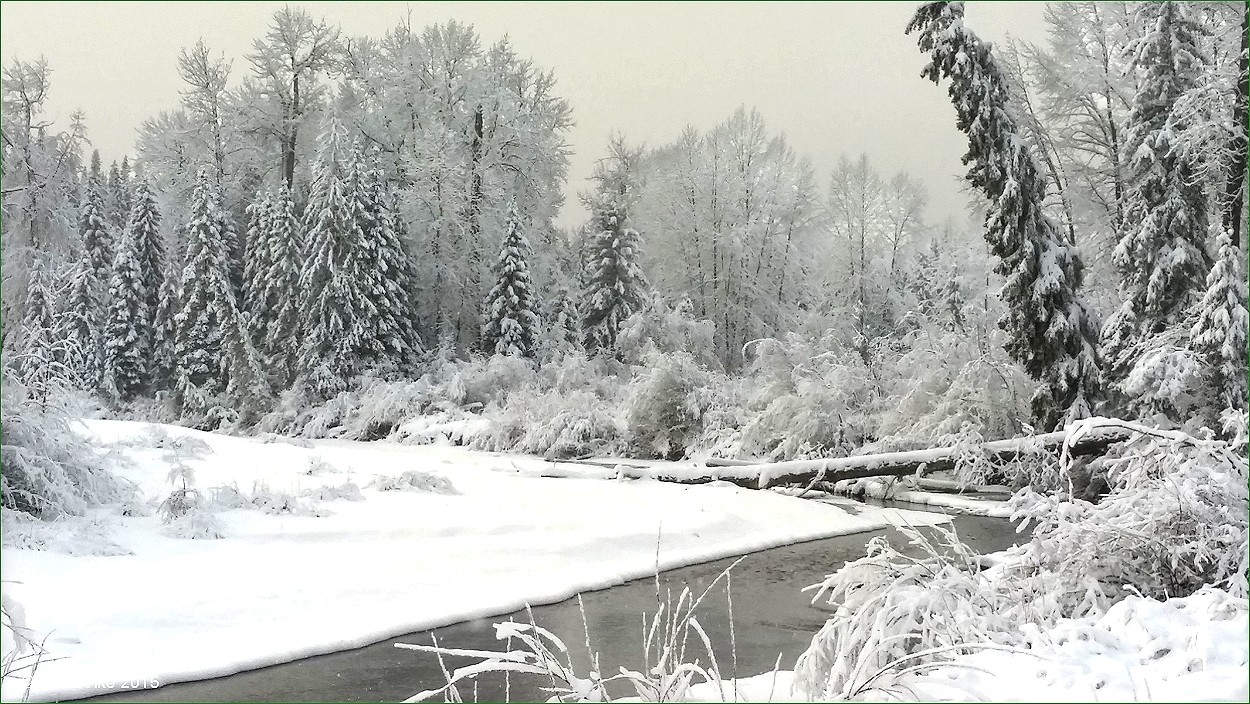
Winter Scene - Travel To Beautiful Houston British Columbia (11 - Pictures)


Above Photo: The Bulkley River filmed from the Bulkley Valley bridge.

Well another dawn arrived in Houston, B.C. with yet another heavy snowfall on the ground. Everything, I mean everything is white. So on December 13, 2015 I headed out harmed with camera, water and pop to one of my favorite places around Houston.

Knockholt for me holds a lot of good memories, my kids when younger would swim in the Bulkley River at Knockholt. Then my daughters kids did the same. They could build sandcastles with moat, ride inner tubes down the river or just splash around having a good old time. 


Above Photo: CN Railway line crossing McKilligan Road.

The scenery there never lets you down, and the beauty about this location is that you can drive right to it. From Houston heading east the distance is only a 8.6km drive along Highway 16 and make a right hand turn onto McKilligan Road, a few hundred yards down the road and you can park your vehicle and within a few steps you are sitting by the river. 


Above Photo: Three of 15 Bald Headed Eagles sitting in the trees around the Bulkley River.

At this location there are two beaver dams on the river which has a lot of water backed up. Today there was a stack of Bald headed Eagles there, I don’t know why they were hanging out in this one area, maybe for fish or a beaver as there was a small open area in the ice.


Above Photo: A bit of open water on the Bulkley River. 

For folks who want to take a break from winter, there is the Houston leisure facility. This facility on a cold snowy day is just perfect to take the family to. There is the popular lazy river with hydro air jets, a 20-person swirl pool and steam room. There is a viewing area at poolside for the moms, dads and grandparents so they can see how their little ones improved on their swimming moves, plus there are lifeguards always on duty. The leisure facility also has a 1,600 square foot gym with weight training equipment and free weights and cardio machines available.


 Above Photo: A blanket of snow covers everything at the Bulkley River.

Houston Leisure Facility:


Above Photo: A blanket of snow covers everything at the Bulkley River.

If you don’t want to get wet, then there is the Houston Public Library where you can grab a good book, curl up on one of the comfy couches, or surf the internet free for something interesting to build or look at. There are magazines and newspapers available, and you can even pick out a free DVD movie to take home. Of course the library has so much more to offer, so the next time you have some free time on your hands, check out the Houston Public Library. 

Houston Public Library website:


Above Photo: A blanket of snow covers everything at the Bulkley River.

With winter at our doorstep, people still like to play in the cold, even if it is indoors, there is the Houston and District Curling Club for men and women of all ages. Also if you are planning some type of event, you can rent the upstairs.

For more information and direction to the Curling Club, please visit the following link:


Above Photo: A blanket of snow covers everything at the Bulkley River.

If you are into strapping on a pair of ice skates, you can go skating at the Claude Parish Memorial Arena, or take in one of the hockey games. There are lots of things to do in Houston, which I have talked about in previous postings, so all you need is to use a little imagination and your off.


Above Photo: A heavy blanket of snow covering everything.

Houston and District Chamber Of Commerce/Visitors Centre website:


Above Photo: A heavy blanket of snow covering everything.


Above Photo: A heavy blanket of snow covering everything.


Travel British Columbia with Brian Vike.

Travel Houston, British Columbia with Brian Vike.

Tuesday, September 15, 2015

A Beautiful Place To Visit - Granisle British Columbia (Photos)


Above Photo: Welcoming you to Granisle British Columbia.

A few days ago my wife and I took a drive up to Granisle British Columbia, which is only a 58 minute from home here in Houston, B.C. and  approximately 78.2 km by way of the Yellowhead Highway 16 east and Central Babine Lake Highway 118.

We stopped along the way as I wanted to take some photos of a few things I had seen while driving the highway in the past. As we made our way into Granisle, and on the left hand side of the road stood a brand new sign welcoming visitors to the village of Granisle.

Now I had not been up to Granisle for some years, although it is rather close to home, I just never made it back. Now from my recent visit, I was pleasantly surprised, not only did Granisle have a new sign, but entire makeover on the grounds of the Granisle Visitors Centre. 


Above Photo: Granisle's Visitors Centre.

In front of me was the Granisle Memorial Park, a large area in grass, with a black walkway that felt like you were walking on a sponge, it was really nice. Also on the grounds were new trees which were already turning colors, reds and golden colored leaves with us now into the fall season. 

There were colorful flowers that were still in bloom, evergreen trees which in time will grow to be giants, giving people shade while enjoying in the park. There were new picnic tables for folks to have a meal on, also there were park bench's scattered about, where one could sit back to admire everything that was in the park, and it truly is a beautiful place to be.

Also at the Granisle Visitors Centre is a museum, which holds artifacts from around Granisle, and even mammoth bones from ages past.


Above Photo: Large bucket in the Granisle Memorial Park used to dig up mineral at one of the mines that was operating around Granisle.

If you haven't visited Granisle before and maybe plan to, bring your cameras as wildlife can be seen roaming throughout the area, from Grizzly, Black bear, Deer, Moose and everything B.C. has to offer. Bring your fishing rods as fishing in the area is awesome, I should know as I fished many lakes around Granisle. 

There is hiking past gorgeous scenery, canoeing along the shores of Babine Lake, camping, biking and the list goes on. In the winter months there is snow shoeing, cross country skiing and ice fishing. It really is endless when you have such a wonderful place to visit.


Above Photo: Some of the colorful trees seen in the Granisle Memorial Park.

I know I will be back, and I am sure the residents of Granisle will welcome you to their little bit of paradise .

Below text information provided from Wikipedia, the free encyclopedia.

Granisle is a village on Babine Lake in the Northern Interior of British Columbia, Canada, to the north of Topley between Burns Lake and Houston.

History

The early inhabitants of the area were Carrier Indians, called "Babine" by the early explorers, referring to the distended ornamented lower lips of the native women.


Above Photo: The soft black walkway seen in the Granisle Memorial Park.

The village of Granisle was founded in the late 1960s and early 1970s on the shores of Babine Lake as a home for the families of the miners working in the nearby copper mines. Granisle was incorporated as a village in 1971. At the height of its population, Granisle boasted approximately 3,000 people.

After the last mine shut down in 1992, the community transformed into a retirement destination. Tourism in the area also began to grow and is now the area's main industry.

In 1971 workmen excavating in an open-pit copper mine at Babine Lake discovered the partly articulated skeleton of a Columbian Mammoth. The bones were taken from silty pond deposits overlain by very thick boulder-clay deposited by the last glacier that covered the area. Radiocarbon dates indicate that the animal sank in sticky pond deposits about 34,000 years ago. A replica of some of the Mammoth's Bones can be seen at the Granisle Museum.


Above Photo: Also in the Granisle Memorial Park, it appears to be an amphitheater where folks can host events from, or maybe where a band performs from.


Above Photo: Babine Lake seen from Granisle, B.C.


Above Photo: Boats tied up at the marina on Babine Lake in Granisle. 

Welcome to the Village of Granisle's webpage.

If you have a picture or story you would like to share on the Travel British Columbia with Brian Vike blog, please contact me at b_vike@telus.net

Travel British Columbia with Brian Vike.

Travel Houston, British Columbia with Brian Vike.

Saturday, July 25, 2015

A Beautiful Scene From Cariboo Country British Columbia (Picture)


For the below photo, I had taken the Greyhound bus down to see my Dad in Langley, B.C. from my home town of Houston. After my visit I headed back home on the bus and along the way I spotted this amazing scene and snapped the photo from the moving bus. 

This is one of my favorites from the trip.

Source information from Wikipedia, the free encyclopedia. https://en.wikipedia.org/wiki/Cariboo

The Cariboo is an intermontane region of British Columbia along a plateau stretching from the Fraser Canyon to the Cariboo Mountains. The name is a reference to the caribou that were once abundant in the region. 

The Cariboo was the first region of the Interior north of the lower Fraser and its canyon to be settled by non-indigenous people, and played an important part in the early history of the colony and province. 

The boundaries of the Cariboo proper in its historical sense are debatable, but its original meaning was the region north of the forks of the Quesnel River and the low mountainous basins between the mouth of that river on the Fraser at the city of Quesnel and the northward end of the Cariboo Mountains - an area that is mostly in the Quesnel Highland and focused on several now-famous gold-bearing creeks near the head of the Willow River, the richest of them all, Williams Creek, the location of Barkerville, which was the capital of the Cariboo Gold Rush and also of government officialdom for decades afterwards (it is now a museum town). 

This area, the Cariboo goldfields, is underpopulated today, but was once the most settled and most powerful of the regions of the province's Interior. 

As settlement spread southwards of this area, flanking the route of the Cariboo Road and spreading out through the rolling plateaus and benchlands of the Cariboo Plateau and lands adjoining it along the Fraser and Thompson, the meaning changed to include a wider area than the goldfields.

The grasslands of the Cariboo are home of the endangered American badger.


If you have a picture you would like to share on this page from around Houston, please contact me at b_vike@telus.net

Thursday, July 23, 2015

Travel British Columbia By Way Of VIA Rail Canada


To make reservations for a beautiful, scenic trip by way of train through British Columbia, or other points of interest, please visit the VIA Rail Canada website at http://www.viarail.ca/

Below picture and videos clips: I took the photo and 2 videos clips at the VIA train station in Houston, British Columbia.

Video Clips Below:  VIA Rail Canada stopping in Houston, British Columbia to pick up and let off passengers. 

Make you next holiday by train in British Columbia, Canada.


The clip can be found on YouTube at: http://youtu.be/lXM1CGB3G1w

Video Below: VIA Rail leaving Houston, British Columbia passing through many small communities.

The clip can be found on YouTube at: http://youtu.be/-ngPqNuy2j8

If you have a picture you would like to share on this page from around Houston, please contact me at b_vike@telus.net