Showing posts with label Kamloops. Show all posts

Saturday, March 12, 2016

Tranquille River Kamloops British Columbia (Picture/Links)


Above Photo: The Tranquille River in Kamloops, British Columbia.

For larger view of the photo, click on the picture.

The Tranquille River is a great place to explore, and pan for gold. I saw a video up on YouTube where a fellow managed to pan some nice gold, so you might like to give it a try.

I also have some other pictures from the area, and these can be found here:

Amazing little man formation and the Tranquille River in 
Kamloops, British Columbia (Pictures/Video)


Travel British Columbia with Brian Vike blog, please contact me at b_vike@telus.net

Travel British Columbia with Brian Vike.

Travel Houston, British Columbia with Brian Vike.

Thursday, January 21, 2016

The 1907 Heritage E Stuart Wood School Kamloops British Columbia (Pictures)


Above Photo: The 1907 E Stuart Wood School in Kamloops, British Columbia.

The 1907 E Stuart Wood School is a beautiful red bricked three-story schoolhouse and was named the Kamloops Public School. Later in 1922 the school was renamed in honour of teacher Edward Stuart Wood who would later become principal of the school. The school was built by a local contractor using local brick from around the area.

The school served elementary grades and high school grades, with the elementary students being taught on the first two floors and the high school students on the top floor until 1913. Now a days the school serves as a elementary school.

The below text information is From Wikipedia, the free encyclopedia:


              History and Heritage:

During Kamloops' evolution in the 19th century, the West End was the main site of residential settlement in the growing town.

The name of Nicola Wagon Road in the neighbourhood bears witness to the fact that the West End was the first concentration of inhabitation in what would become one of British Columbia's most spread-out cities.

The West End was home to many of Kamloops' most prominent early citizens, as demonstrated by the size and grandeur of many of the homes.

While a number of more modern houses have encroached upon the neighbourhood's elegant atmosphere, wood-paneled and stucco homes remain the norm.

The neighbourhood is located close to a number of significant Kamloops buildings, including the Old Courthouse, Sacred Heart Cathedral, St. Andrew's on the Square, Stuart Wood Elementary School (the city's first school), the Kamloops Museum and Archives and St. Ann's Academy.

William Tuff Whiteway was the architect/designer of the E Stuart Wood School.

William Tuff Whiteway (1856–1940) was a Canadian architect best known for his work in the early 1900s in Vancouver, although he received commissions in various parts of the United States and Canada during his peripatetic career.

Biography: William Tuff Whiteway.


Whiteway was born in Musgrave Harbour, Newfoundland and Labrador, in 1856.[1] He moved to Victoria, British Columbia in approximately 1882, to Vancouver in 1886, and to San Diego in 1887. In 1888, he moved to Port Townsend, Washington, where he practiced architecture with his partner Julius C. Schroeder. 


In 1892, he left Port Townsend for St. John's, Newfoundland and Labrador, and then moved to Halifax where he partnered with William T. Horton. In 1900, Whiteway returned to Vancouver, where he remained until his death in 1940.

During his career he was repeatedly in conflict with the Architectural Institute of British Columbia for nonpayment of membership fees, and for undercutting the minimum fees that the Institute imposed on transactions with clients. 


He was also criticized by the Institute for working with an unlicensed architect, W.H. Chow, who was barred from licensing because of his race.

Another element of controversy surrounds whether he truly designed the most famous work attributed to him, the World Building (now Sun Tower) of Vancouver. Another highly successful Vancouver architect of the era, George L.T. Sharp (1880–1974), has claimed the initial sketch was his, not Whiteway’s.


Travel British Columbia with Brian Vike blog, please contact me at b_vike@telus.net

Travel British Columbia with Brian Vike.

Travel Houston, British Columbia with Brian Vike.

Tuesday, December 29, 2015

Kamloops Lake - Thompson River – City Of Kamloops British Columbia (6 - Pictures)


Above Photo: Over looking the city of Kamloops, British Columbia.

As we travel around Kamloops, B.C. there is so much to see and never enough time to see it all. I wanted to take a few pictures of Kamloops Lake, the Thompson River and the city of Kamloops from a higher vantage point, which I did, but at dusk. 

For information about Kamloops, please visit Tourism Kamloops at:

The below text is from Wikipedia, the free encyclopedia:

Kamloops Lake in British Columbia, Canada is situated on the Thompson River just west of Kamloops. The lake is 1.6 km wide, 29 km long, and up to 152 m deep. The community of Savona is located at the west end of the lake on the Thompson River. The city of Kamloops is located a few miles east of the head of the lake, at the confluence of the North and South Thompson Rivers.


Above Photo: Kamloops Lake and the Thompson River in Kamloops, British Columbia.

The lake is bounded on all sides by steep embankments, with level areas found only near creek deltas and around the inlet and outlet. The surrounding land is mostly uninhabited. It is classified as dry belt interior grasslands, composed of bunchgrass and sagebrush with pockets of Douglas fir, Ponderosa pine and spruce.


Above Photo: Kamloops Lake and the Thompson River in Kamloops, British Columbia.

Kamloops Lake is a widening and deepening of the Thompson River, which enters at the east end and exits at the west end. The limnology of the lake is controlled by the Thompson River, which has large fluctuations in annual flow, with over 60% occurring in the early summer during freshet (May to July). Lake levels rise naturally as much as 30 feet (9.1 m) from high season in June compared to low season. Conversely, beach areas expand by as much as 200 feet (61 m) in the summer as lake levels recede after freshet.


Above Photo: The Thompson River in Kamloops, British Columbia.

Bulk residence times are very short (the time it takes for the water in the lake to be replaced with new water), ranging from 20 days to 340 days, with a mean of 60 days. Because Kamloops Lake is fed by both the North and South Thompson rivers (the South Thompson drains from the very warm Shuswap Lakes), Kamloops Lake is a very warm lake. 

Since the late twentieth century, it has become an increasingly popular boating and recreational area. On the north side of the lake is Fredrick, and on the south side of the lake are residential subdivisions such as Cherry Creek and the Tobiano resort community. A boat launch, trestle and gas dock have been built at Tobiano; it is the only location on Kamloops Lake with these facilities. Both Savona and Kamloops also have boat launches, but their use is limited in the later summer months of low water.

North Thompson River:

From Wikipedia, the free encyclopedia:

The North Thompson River is the northern branch of the Thompson River, the largest tributary of the Fraser River, in the Canadian province of British Columbia. It originates at the toe of the Thompson Glacier in the Premier Range of the Cariboo Mountains, west of the community of Valemount. 


Above Photo: Over looking the city of Kamloops, British Columbia.

The river flows generally south through the Shuswap Highland towards Kamloops where it joins the South Thompson River to form the main stem Thompson River.

For most of its length, the river is paralleled by Highway 5, and the Canadian National Railway (both of which cross the river a couple times). The North Thompson passes by several small communities, the most notable being Blue River, Clearwater, and Barriere.

Tributaries of the North Thompson River including the Albreda River, Thunder River, Mud Creek, Blue River, Mad River, Raft River, Clearwater River, and Barrière River.

The North Thompson's largest tributary is the Clearwater River, which joins at the town of Clearwater. The Clearwater River drains much of Wells Gray Provincial Park.


Above Photo: Over looking the city of Kamloops, British Columbia.

A notable feature along the North Thompson is Little Hells Gate, a mini-replica of the much larger Hells Gate rapids on the Fraser River. About 17.4 kilometres (10.8 mi) upstream from the small town of Avola, the North Thompson River is forced through a narrow chute only about 30 feet (9.1 m) wide, creating a rapid that resembles the Fraser's famous rapid. Many river rafting companies offer a variety of trips through the rapids.

Travel British Columbia with Brian Vike blog, please contact me at b_vike@telus.net

Travel British Columbia with Brian Vike.

Travel Houston, British Columbia with Brian Vike.

Monday, December 28, 2015

Heritage Railway And Station Located In Kamloops British Columbia (13 - Pictures)


Above Photo: Welcome sign for travelers visiting Kamloops, British Columbia.

For myself trains have held a special place in my life. It started when I was a little guy when I received my first train on Christmas day. I was so excited as my Dad handed out the presents, and in one of the wrapped boxes was a locomotive, box cars, tracks and small houses. I quickly opened up the box pulling everything out onto the floor in one pile. 

I knew exactly how it was supposed to be put together, at least I thought so. My dad sat with me as we both transformed a pile of plastic and metal into a working model railroad. I was so happy with a smile from ear to ear.


Above Photo: Electrical box with picture of folks from years past dressed up to the hilt standing on the railway station platform waiting for the train.

As the years went by, we decided to build a larger scale railway, but little did I realize that it wasn’t going to be just a bit larger, it was going to be huge as it took up the entire recreation room in the basement. It was great and we had a lot of fun putting it together and then operating it.

So when my daughter drove me to the Kamloops Heritage Railway, I was just like that kid again on Christmas day. It was off season as we were in Kamloops in November of 2015, so I could not experience the ride the train took tourists on, plus the cowboys on horse back robbing the train.


Above Photo: Kamloops, British Columbia 1927 railway station.

The next time we visit my daughter, I will be the 64 year old sitting on the train with a 
smile from ear to ear.

So make your holiday stop in Kamloops, British Columbia where all your dreams will come true as did mine.

The below text From Wikipedia, the free encyclopedia.
https://en.wikipedia.org/wiki/Kamloops_railway_station

Kamloops Railway Station:

Kamloops railway station in Kamloops, British Columbia, Canada is a railway station which acts as the overnight stopover point for the Rocky Mountaineer train service to Jasper, Banff and Calgary; from Vancouver.


Above Photo: Kamloops, British Columbia 1927 railway station.

The station circa 1927

The station was originally built for Canadian National Railway. The station was declared a Heritage Railway Station in 1992. Via Rail trains call at the Kamloops North railway station not this station. The station building was restored and houses The Keg restaurant.

The Kamloops Heritage Railway, offers special excursion steam trains at various times through the year, trains depart from the station with tickets sold from their ticket office at 
5-510 Lorne St near the station.


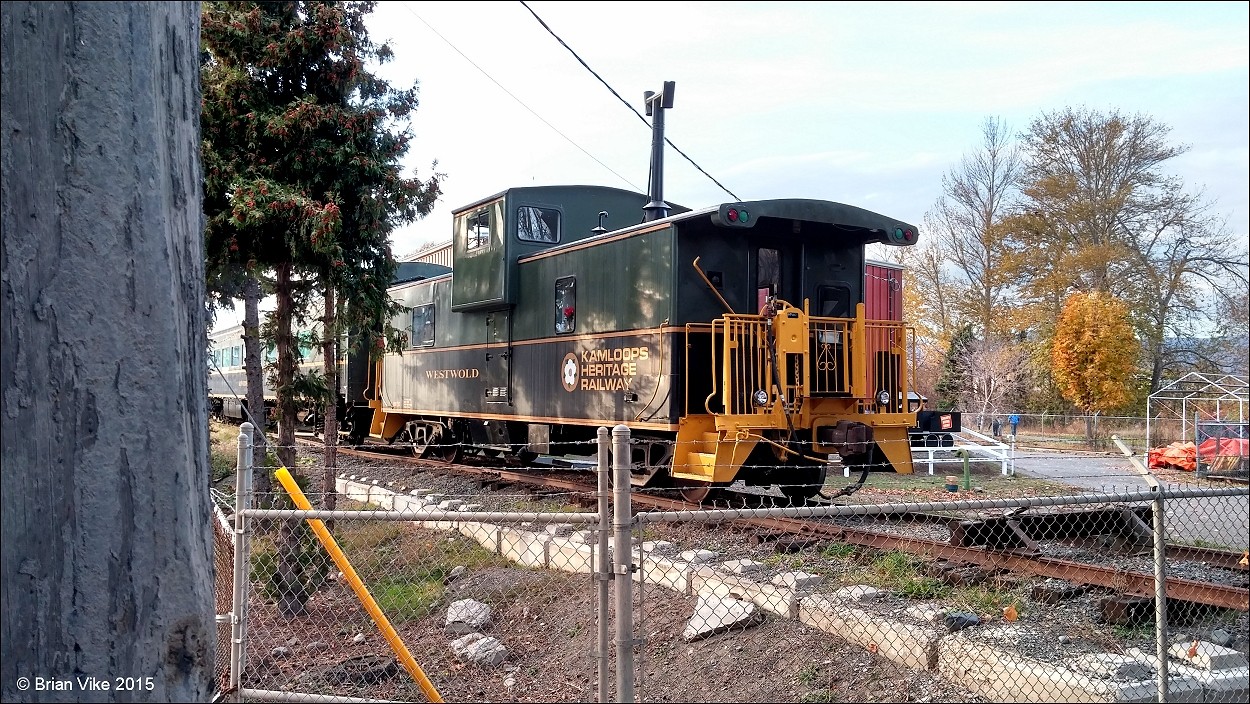
Above Photo: This train Caboose is part of the Kamloops, B.C. Heritage Railway.

Kamloops Heritage Railway:

The Kamloops Heritage Railway is a heritage railway in Kamloops, British Columbia. The railway operates throughout the year running trains within Kamloops. The train is pulled by restored steam locomotive Canadian National Railway 2141, the "Spirit of Kamloops".


Above Photo: This train Caboose is part of the Kamloops, B.C. Heritage Railway.

2141 was built in 1912 by the Canadian Locomotive Company, in Kingston, ON - built for the Canadian Northern Railway, prior to it being absorbed into the Canadian National Railway. She is a 2-8-0, 'Consolidation' class of steam locomotive built for branch line railways. 


Above Photo: A Beautiful mural painting and miniature engine and town.

Originally a coal burner, she was converted to burn oil in 1954, and retired from active duty in 1958. 2141 was sold to the City of Kamloops in 1961, and placed on display in Riverside Park until restoration work began in 1995. 


Above Photo: Pictures of the passenger cars for the railroad.

The restoration was completed in 2001, and 2141 has been working for KHR from May until December each year since. A second restoration took place from 2013 to 2015, with the engine running again in August 2015.

Tickets for excursions are sold at the ticket office, located at #3-510 Lorne Street, right across from the old Kamloops railway station. The heritage station now houses the Keg restaurant.


Above Photo: Pictures of the passenger cars for the railroad.

Kamloops Heritage Railway:

Kamloops Heritage Railway:


Above Photo: Bright orange snow plow used by the railroad companies to 
remove snow from the tracks.

Kamloops Railway Station:


Canadian Rail: The Railway History of Kamloops, B.C. (Excellent Article)


Above Photo: Bright orange snow plow used by the railroad companies to 
remove snow from the tracks.

Kamloops Visitor Centre: (Contact for information on things to do in Kamloops)


Above Photo: The well known Red Bridge is located at the end of the Heritage Railway's property in Kamloops, British Columbia.


Above Photo: Picture of the Jail, Befurts Saloon and Hotel and Odgaard's Feed and Tack. Also my Daughter and Grandson hamming it up outside the Saloon after a cold Root Beer.

Travel British Columbia with Brian Vike blog, please contact me at b_vike@telus.net

Travel British Columbia with Brian Vike.

Travel Houston, British Columbia with Brian Vike.

Sunday, December 27, 2015

Back Alley Mural Paintings Kamloops British Columbia (23 - Pictures)


Above Photo: Just one of the amazing Back Alley Mural Paintings that is found in 
Kamloops, British Columbia.

During our visit with family in Kamloops, British Columbia, my daughter drove me to a back alley in the downtown area. I did wonder where she was taking me, but it soon became very clear as I my face lit up. All of the buildings along this back alley had beautiful murals painted on them by some very clever people. 


Above Photo: Just one of the amazing Back Alley Mural Paintings that is found in 
Kamloops, British Columbia.

The back alley murals are amazing and when visiting Kamloops, B.C. make sure you take time to visit this wonderful work of art.

Back Alley Art Gallery.

Location Map for the Back Alley Mural Paintings in Kamloops, B.C.

Kamloops Visitor Centre.


Above Photo: Just one of the amazing Back Alley Mural Paintings that is found in 
Kamloops, British Columbia.


Above Photo: Just one of the amazing Back Alley Mural Paintings that is found in 
Kamloops, British Columbia.


Above Photo: Just one of the amazing Back Alley Mural Paintings that is found in 
Kamloops, British Columbia.

Below I have listed some information about Kamloops I am sure you will enjoy reading.

The below text information is from Wikipedia, the free encyclopedia:

Kamloops History:

Prior to the arrival of European settlers, the Cree-Saulteaux band led by Chief Yawassannay had migrated to this region in the early 15th century where they met the local Secwepemc (Shuswap) nation (part of the Interior Salish language group). The Yawassanay band's Kamloops settlement was the largest of their three tribal areas. 


Above Photo: Just one of the amazing Back Alley Mural Paintings that is found in 
Kamloops, British Columbia.

The first European explorers arrived in 1811, in the person of David Stuart, sent out from Fort Astoria, then still a Pacific Fur Company post, and who spent a winter there with the Secwepemc people, with Alexander Ross establishing a post there in May 1812 - "Fort Cumcloups".

The rival North West Company established another post - Fort Shuswap - nearby in the same year. The two operations were merged in 1813 when the North West Company officials in the region bought out the operations of the Pacific Fur Company. 


Above Photo: Just one of the amazing Back Alley Mural Paintings that is found in 
Kamloops, British Columbia.

After the North West Company's forced merger with the Hudson's Bay Company in 1821, the post became known commonly as Thompson's River Post, or Fort Thompson, which over time became known as Fort Kamloops. 

The post's journals, kept by its Chief Traders, document a series of inter-Indian wars and personalities for the period and also give much insight to the goings-on of the fur companies and their personnel throughout the entire Pacific slope.


Above Photo: Just one of the amazing Back Alley Mural Paintings that is found in 
Kamloops, British Columbia.

Soon after the forts were founded, the main local village of the Secwepemc, then headed by a chief named Kwa'lila, was moved close to the trading post in order to control access to its trade, as well as for prestige and protection. With Kwalila's death, the local chieftaincy was passed to his nephew and foster-son Chief Nicola, who led an alliance of Okanagan and Nlaka'pamux people in the plateau country to the south around Stump, Nicola and Douglas Lakes.

Relations between Nicola and the fur traders were often tense but in the end Nicola was recognised as a great help to the influx of whites during the gold rush, though admonishing those who had been in parties waging violence and looting on the Okanagan Trail, which led from American territory to the Fraser goldfields.

Throughout, Kamloops was an important way station on the route of the Hudson's Bay Brigade Trail, which originally connected Fort Astoria with Fort Alexandria and the other forts in New Caledonia to the north (today's Omineca Country, roughly), and which continued in heavy use through the onset of the Cariboo Gold Rush as the main route to the new goldfields around what was to become Barkerville.


Above Photo: Just one of the amazing Back Alley Mural Paintings that is found in 
Kamloops, British Columbia.

The gold rush of the 1860s and the construction of the Canadian Pacific Railway, which reached Kamloops from the West in 1883, brought further growth, resulting in the City of Kamloops being incorporated in 1893 with a population of about 500. The logging industry of the 1970s brought many Indo-Canadians into the Kamloops area, mostly from the Punjab region of India. In 1973, Kamloops annexed Barnhartvale and other nearby communities.


Above Photo: Just one of the amazing Back Alley Mural Paintings that is found in 
Kamloops, British Columbia.

Etymology:

"Kamloops" is the anglicised version of the Shuswap word "Tk'əmlúps", meaning 'meeting of the waters'. Shuswap is still spoken in the area by members of the Tk'emlúps Indian Band.

An alternate origin sometimes given for the name may have come from the native name's accidental similarity to the French "Camp des loups", meaning 'Camp of Wolves'; many early fur traders spoke French. One story perhaps connected with this version of the name concerns an attack by a pack of wolves, much built up in story to one huge white wolf, or a pack of wolves and other animals, traveling overland from the Nicola Country being repelled by a single shot by John Tod, then Chief Trader, thus preventing the fort from attack and granting Tod a great degree of respect locally.


Above Photo: Just one of the amazing Back Alley Mural Paintings that is found in 
Kamloops, British Columbia.

Industry:

Industries in the Kamloops area include primary resource processing such as Domtar Kamloops Pulp Mill, Tolko-Heffley Creek Plywood and Veneer, Lafarge Cement, Highland Valley Copper Mine (in Logan Lake), and others. RIH (Royal Inland Hospital) is the city's largest employer. TRU (Thompson Rivers University) serves a student body of 10,000 including a diverse international contingent mainly from Asian countries. Thompson Rivers University, Open Learning (TRU-OL) is the biggest distance education provider in British Columbia and one of the biggest in Canada.

There are tertiary industrial sector entities such as:


Above Photo: Just one of the amazing Back Alley Mural Paintings that is found in 
Kamloops, British Columbia.

Culture:

Kamloops is home to many galleries including nationally recognized Kamloops Art Gallery, The Kamloops Museum and Archives, the Kamloops Symphony Orchestra, Western Canada Theatre, the British Columbia Wildlife Park, the Kamloops Heritage Railway, Kenna Cartwright Park and Riverside Park. Kamloops is also well known for its public art including numerous pole carvings and murals.


Above Photo: Just one of the amazing Back Alley Mural Paintings that is found in 
Kamloops, British Columbia.

Transportation:

Kamloops is a transportation hub for the region due to its connections to Highways 5 and 97, the Trans-Canada and Yellowhead Highways.


Above Photo: Just one of the amazing Back Alley Mural Paintings that is found in 
Kamloops, British Columbia.

Kamloops is also a rail transportation hub. The Canadian Pacific (CPR) and Canadian National (CNR) main line routes connect Vancouver BC in the west with Kamloops. The two rail roads diverge to the north and east where they connect with the rest of Canada. Kamloops North railway station is served three times per week (in each direction) by Via Rail's The Canadian.


Above Photo: Just one of the amazing Back Alley Mural Paintings that is found in 
Kamloops, British Columbia.

Kamloops is home to Kamloops Airport (Fulton Field), a small Regional airport currently being expanded, with construction underway into 2010. Airlines currently flying to Kamloops are Air Canada, WestJet and Central Mountain Air.

Greyhound Canada connects Kamloops with Vancouver, Edmonton and Calgary.

Local bus service is provided by the Kamloops Transit System.


Above Photo: Just one of the amazing Back Alley Mural Paintings that is found in 
Kamloops, British Columbia.

Geography and Location:

Kamloops is situated in the Thompson Valley and the Montane Cordillera Ecozone. The central core of the city is located in the valley near the confluence of the north and south branches of the Thompson River. Suburbs stretch for more than a dozen kilometres along both north and south branches, as well as to the steep hillsides along the south portion of the city and lower northeast hill sides.


Kamloops Indian Band areas begin just to the northeast of the downtown core but are not located within the city limits. As a result of this placement, it is necessary to leave Kamloops' city limits and pass through the band lands before re-entering the city limits to access the communities of Rayleigh and Heffley Creek. Kamloops is surrounded by the smaller communities of Cherry Creek, Pritchard, Savona, Scotch Creek, Adams Lake, Chase, Paul Lake, Pinantan and various others.

Climate:

The climate of Kamloops is semi-arid (Köppen climate classification BSk) due to its rain shadow location. Because of milder winters and aridity, the area west of Kamloops in the lower Thompson River valley falls within Köppen climate classification BWk climate. Kamloops gets short cold snaps where temperatures can drop to around −20 °C (−4 °F) when Arctic air manages to cross the Rockies and Columbia Mountains into the Interior.


Above Photo: Another great Mural of a train found in the same area.

The January mean temperature is −2.8 °C (27 °F). That average sharply increases with an average maximum temperature of 4.3 °C (40 °F) in February. The average number of days below −10 °C (14 °F) per year is 19.9 as recorded by Environment Canada.


Above Photo: Another great Mural of a train found in the same area.

Although Kamloops is located above 50° north latitude, summers are warmer than in many places at lower latitudes, with prevailing dry and sunny weather. Daytime humidity is generally under 40% in the summer, sometimes dropping below 20% after a dry spell, which allows for substantial nighttime cooling. Occasional summer thunderstorms can create dry-lightning conditions, sometimes igniting forest fires which the area is prone to.

Kamloops lies in the rain shadow leeward of the Coast Mountains and is biogeographically connected to similar semi-desert areas in the Okanagan region, and a much larger area covering the central/eastern portions of Washington, Oregon and intermontane areas of Nevada, Utah and Idaho in the US.


Above Photo: Another great Mural of a train found in the same area.

These areas of relatively similar climate have many distinctive native plants and animals in common, such as ponderosa pine (Pinus ponderosa), big sagebrush (Artemisia tridentata), prickly pear cactus (Opuntia fragilis in this case), rattlesnakes (Crotalus viridis), black widow spiders and Lewis's woodpecker.

The hottest temperature ever recorded at the airport, 40.7 °C (105 °F), occurred on 13 July 2014; the hottest reliably accurate temperature ever recorded within the city, 41.7 °C (107 °F), occurred first on 27 July 1939 and again two years later on 16 July 1941.


Above Photo: Another great Mural of a train found in the same area.

Sports:

Kamloops hosted the 1993 Canada Summer Games. It co-hosted (with Vancouver and Kelowna) the 2006 IIHF World U20 Championship from 26 December 2005, to 5 January 2006. It hosted the 2006 BC Summer Games. In the summer of 2008, Kamloops, and its modern facility the Tournament Capital Centre, played host to the U15 boys and girls Basketball National Championship. The city is known as, and holds a Canadian trademark as, Canada's Tournament Capital.

Sun Peaks Resort is a nearby ski and snowboard hill. Olympic medallist skier Nancy Greene is director of skiing at Sun Peaks and the former chancellor of Thompson Rivers University. The Overlander Ski Club runs the Stake Lake cross country ski area with 50 km (31 mi) of trails. 


Above Photo: Another great Mural of a train found in the same area.

Kamloops is home to world-famous mountain bikers such as freeride pioneers and Mountain Bike Hall of Fame members Wade Simmons, Brett Tippie, (also a former Canadian National Team member for snowboard cross and giant slalom), Richie Schley. Also home to freeriders Matt Hunter, and Graham Agassiz. 

Kamloops was featured in the first mountain bike film by Greg Stump, "Pulp Traction", and later the first three "Kranked" films, which starred the original Froriders, Tippie, Simmons and Schley. In 2007, the Kamloops Bike Ranch opened in Juniper Ridge along Highland Drive. The Kamloops Rotary Skatepark located at McArthur Island Park is one of the largest skateboard parks in Canada. Also located at McArthur Island Park is NorBrock Stadium.

Kamloops is home to the Western Hockey League's Kamloops Blazers who play at the Interior Savings Centre. Alumni of the Kamloops Blazers include Mark Recchi, Jarome Iginla, Darryl Sydor, Nolan Baumgartner, Shane Doan, Scott Niedermayer, Rudy Poeschek and Darcy Tucker. 

Two-time champion coach Ken Hitchcock would later win the Stanley Cup with the Dallas Stars. Lacrosse teams include the Thompson Okanagan Junior Lacrosse League's Kamloops Junior B Rattlers, as well as the Kamloops Storm. 


Above Photo: Another great Mural from around Kamloops, B.C.

Also calling Kamloops home is the Canadian Junior Football League's Kamloops Broncos, and Pacific Coast Soccer League's Kamloops Excel, both of whom play at Hillside Stadium.

Soccer for the city includes: Kamloops Youth Soccer Association, Kamloops Blaze rep team and the Kamloops Excel (see above). TRU hosts the Thompson Rivers WolfPack, and has sports teams that include men's and women's volleyball, basketball, soccer and badminton. Also the WolfPack have hockey, rugby, badminton, golf and baseball teams.

Kamloops hosted the World Masters Indoor Championships 2010 on 1–6 March 2010.

Kamloops hosted the 2011 Western Canada Summer Games.

On February 6, 2016, Kamloops will host Hockey Day in Canada with Ron MacLean and Don Cherry.

Travel British Columbia with Brian Vike blog, please contact me at b_vike@telus.net

Travel British Columbia with Brian Vike.

Travel Houston, British Columbia with Brian Vike.